
Importers and exporters
Clear your own goods and follow every operation without chasing updates by email.
Collaborative logistics platform
logictra connects the importer, the freight forwarder, the haulier and the warehouse working on the same shipment. Each one runs its part in its own company workspace, with its own data and prices, and shares with the others only what it chooses to share.
One operation, from order to pro forma invoice
The problem
A routine import involves the importer, the freight forwarder, the customs broker, the haulier and the warehouse. Each of them runs its part in its own software. Whatever happens between them travels by email, by phone and in spreadsheets.
When something changes, someone finds out late. And checking the status of a container takes two phone calls.
Who it's for
They all share the same data model, so an operation can move from one company to another without translation. What changes is the interface: each one sees the screens for its own trade.
Clear your own goods and follow every operation without chasing updates by email.
Third-party clearance, freight, transport and warehousing in a single operation.
Orders that arrive with their data, today's trips and a fleet with its paperwork in order.
3D floor plan, dock arrivals and stock, connected to your client's operation.
Business network
Two logictra companies connect through a tunnel. Only the part of the operation that each of them chooses to share travels through it.
Product
Each company turns on the modules for its line of business. A warehouse doesn't see fleet screens, and an importer that clears its own goods doesn't see transport ones.
A control tower with every operation, its status and its real route by sea and road.
Import declarations and tariff classification by territory, with full history.
Today's trips, vehicles, drivers and documents about to expire.
Your warehouse floor plan in 3D, with zones, locations and dock arrivals.
Each container's cycle, pick-up and return deadlines, seals and demurrage.
One calculator per rate type, versioning and a sale, cost and margin simulator.
Pro forma invoices from the operation, supplier invoices and treasury. Legal invoices in Holded.
Every document attached to its operation, with intake and requests to third parties.
Built-in and custom reports, exportable and scheduled, within each user's permissions.
AEAT, ShipsGo, Holded and email, using your own company's credentials.
Warehouse
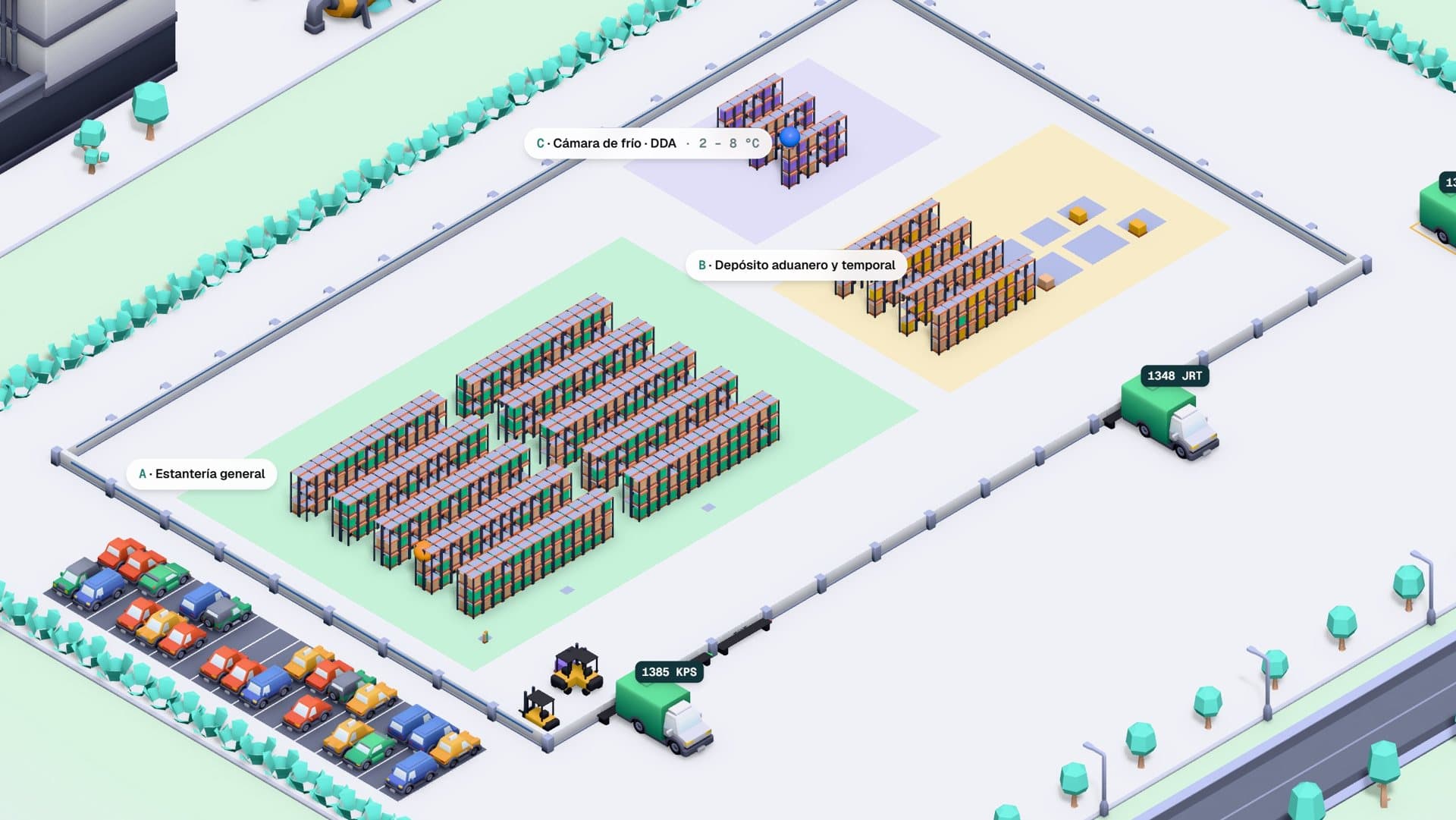
The warehouse home screen draws your building with its real zones: general racking, customs and temporary storage, cold room. On top of it you see the trucks at the dock and the ones on their way.
The floor plan is edited inside the application and uses the data from your locations and arrivals, with no separate mock-ups.
Security
Separation between companies is enforced in the database itself, and every action is traceable.
Every query is filtered by company in PostgreSQL. If the company context is missing, the query returns nothing.
Every change is recorded with who, when and what. Records are chained together, so altering one breaks the chain.
Connections to external services (Spanish Tax Agency, ShipsGo, Holded, email) use your company's own credentials.
The database and the application run in data centres in Frankfurt (Germany).
Frequently asked questions
No. Each company works in its own workspace, and margins, costs and internal rates never leave it. Only the fields of the operation that you choose to share travel through the connection between companies.
You can keep it in your directory with your internal references and work with it as you do today. The connection between companies is enabled when both of them use logictra.
logictra prepares pro forma invoices from the operation. The legal invoice and VERI*FACTU compliance are handled in Holded, with your company's account.
In European Union data centres, in Frankfurt (Germany). The database is PostgreSQL and each company is isolated from the others in the database itself.
No. Each company turns on the modules for its line of business and the menu only shows those.
Request a demo. We'll look at how your company works, which modules you need and which companies it makes sense to connect with first.
We'll show you logictra with sample data for your type of company and look at what you need to get started.